Latest global study of 8,800 consumers from Two Sides shows that responsible organisations should not remove the right from consumers to choose whether they receive paper or digital communications. Undertaken in January 2021, this research explored consumer perceptions and attitudes towards print, paper and paper packaging.
There is a worrying trend from organisations who increasingly want to move their customer communications online, particularly bills and statements. Typically, this decision is made for cost reasons but, too often, misleading statements are used that it is better for the environment. Commonly referred to as Greenwashing.
A recent study, Paper’s Place on a Post-Pandemic World, conducted by the not-for-profit organisation Two Sides and independent research company Toluna, found that consumers overwhelmingly want the right to choose how they receive communications (digitally or printed) from organisations. 76% of UK consumers (74% EU) want this choice.
The right to choose.
Defaulting people online, without choice to save cost, will impact those most vulnerable and at risk in our communities. In the UK, 4.5 million adults have never used the internet (Office of National Statistics, 2018). Often, it is the most vulnerable members of society that depend on traditional, postal, transactional mail. The move to an online only society risks leaving older people, the disabled, rural dwellers and those on low incomes disconnected.
Alongside the right to choose, consumers are also demanding that they are not penalised for selecting paper communications. 58% of UK consumers (54% EU) agree that they should not be charged more for choosing a paper bill or statement. Furthermore, organisations should be careful when forcing their customers online. If a UK consumer were forced to move to digital by their current service providers, 32% (29% EU) would consider switching to an alternative provider.
Digital communication isn’t always preferred.
In a society where everything happens online, organisations are in danger of thinking that digital is always the preferred option. However, this isn’t always the case. 59% of UK consumers (55% EU) are increasingly concerned that their personal information held electronically is at risk of being hacked, stolen, lost or damaged. Over 55-year-olds are the most concerned (64%), however a large number of younger people have the same worry (58% of 25–34 year olds).
Furthermore, even if a consumer is moved to digital bills and statements, it rarely stays “paperless” where 59% of UK consumers (47% EU) regularly print out hard copies at home.
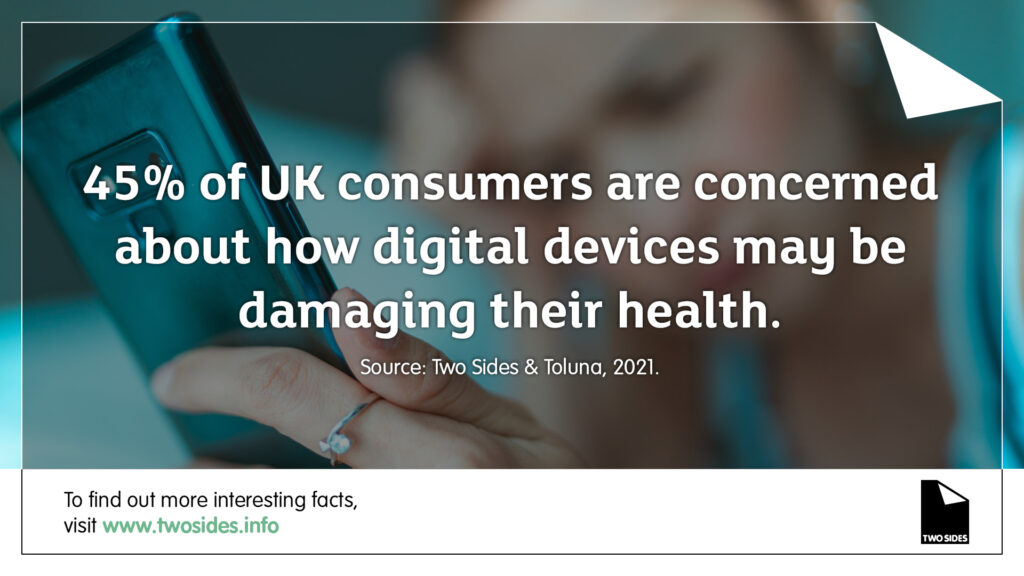
It cannot be denied that digital is having an impact on how we communicate, but the growing dependence on digital brings its own challenges. The survey reveals that getting away from digital devices is more important than ever. 45% of UK consumers (46% EU) are concerned about how digital devices may be damaging their health and 43% agree (49% EU) they spend too much time on their devices.
Connecting with customers
For advertisers, print should also be an opportunity to help rebuild their brands following the long lockdown. The recent survey showed that 53% of UK consumers (51% EU) do their best to block or avoid online adverts, and 60% (55% EU) don’t pay attention to online adverts. Many previous studies have shown the power of direct mail and door drops, which receive a high degree of attention, usually being kept and passed around a household. Post-pandemic, as companies grow and re-establish themselves, print will be a powerful and effective way for brands to connect physically with the consumer.
Which is best; Print or Digital?
Print and digital are often compared in a bid to decide which is best. However, the debate shouldn’t centre around “print vs. digital”, as both channels are important and complement each other. Ultimately, consumers must be given the right to decide how they would like to receive communications; ensuring that consumer choice is maintained and those unwilling or unable to access digital information are not disadvantaged.
The Impact of Greenwashing
Organisations must steer clear from claiming that digital communications are better for the environment than paper communications. A marketing practice known as “Greenwashing”.
Statements such as “Go Green, Go Paperless” are not just misleading but hugely damaging to an industry that employs in the UK alone, 116,000 people (1,096,000 EU), in more than 8,400 business (115,700 EU).
It is reassuring to know that half of consumers are not fooled by organisations that want them to switch from paper to digital communications based on environmental grounds. 52% of UK consumers (49% EU) know that this is down to cost saving.
Two Sides continues to actively challenge major organisations found to be misleading consumers by using environmental claims about the use of paper. But we can only do this with the support of the industry.
For more information visit https://www.twosides.info/become-a-member/
To request the Executive Summary of this report, please email enquiries@twosides.info