Epson has released a valuable guide to evaluating how today’s textile print options stack up for those looking to expand their service offering, develop broader application possibilities and grow their production horizons.
Both production processes are predicted to see exciting growth driven by increased interest in sustainability, customisation and creativity. The main difference between the two is the type of materials that can be printed on – cotton or polyester.
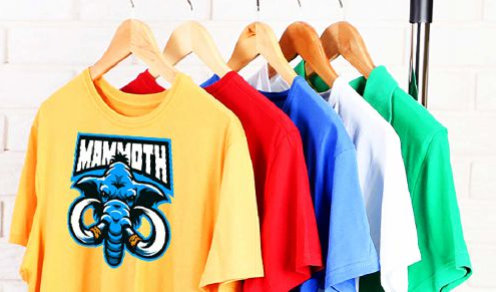
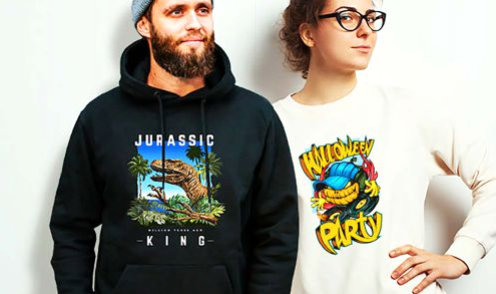
With DTG, as the name suggests, artwork is printed directly onto the garment. The technology uses water-based CMYK and white pigment ink, in which inks can print on dark or light-coloured textiles, t-Shirts, hoodies, jumpers or any 100 percent cotton
garment. It is possible to print onto poly/cotton blends as long as cotton content is 50 percent.
With dye-sublimation, artwork is printed in full colour onto transfer paper using dye sublimation ink and paper. The ink is then transferred from the paper to the fabric using heat and pressure. It works best with white, 100 percent polyester and, as such, is suited to sportswear and fashion.
New revenue streams
When DTG printing the garment is loaded onto the printer platen and the inks are applied directly. When printing onto dark garments an underlayer of white ink is printed first whilst for light coloured garments only CMYK is used, making them quicker to produce.
Pre-treatment is optional for light garments (improves vibrancy), but essential for dark garments. A heat press or tunnel dyer is then used post print to cure the inks.
Dye-sublimation is a two-step process that that uses dye sublimation inks. The image is mirrored in the driver of RIP software before being printed on sublimation transfer paper. The process is then completed by bringing the design together with substrate and applying heat and pressure.
DTG printers are generally scalable and simple to run as part of a workflow, making it is easy to produce a steady volume of garments. As the garments are already finished a potential bottleneck can be avoided post print, but applications are limited to off the shelf, cotton-based products.
Designs on dye-sublimation
Dye-sublimation is a more involved process but supports greater application variety and much more freedom in terms of finished output or product. For example, once a roll of fabric has been printed, it could then be cut and sewn into all manner of garments or products.
The key benefit for both is that they enable onsite, on-demand textile printing, producing a low carbon footprint in comparison to traditional textile production. The fashion industry produces 20 percent of all global wastewater and 10 percent of global carbon emissions, but localising fashion using more on-demand digital printing can save up to 4kg of CO2 per item.
Epson’s benchmark of reliable DTG printing, the SureColor SC-F2100, has recently been joined by the SureColor SC-F3000, designed for higher volume users requiring increased productivity and a low total cost of ownership. The dye-sublimation solutions in Epson’s growing portfolio range from entry to industrial level, including its first A4 dye-sublimation printer, the SureColor SC-F100, up to our 255sqm/hr SureColor SC-F10000 76” wide-format printer.