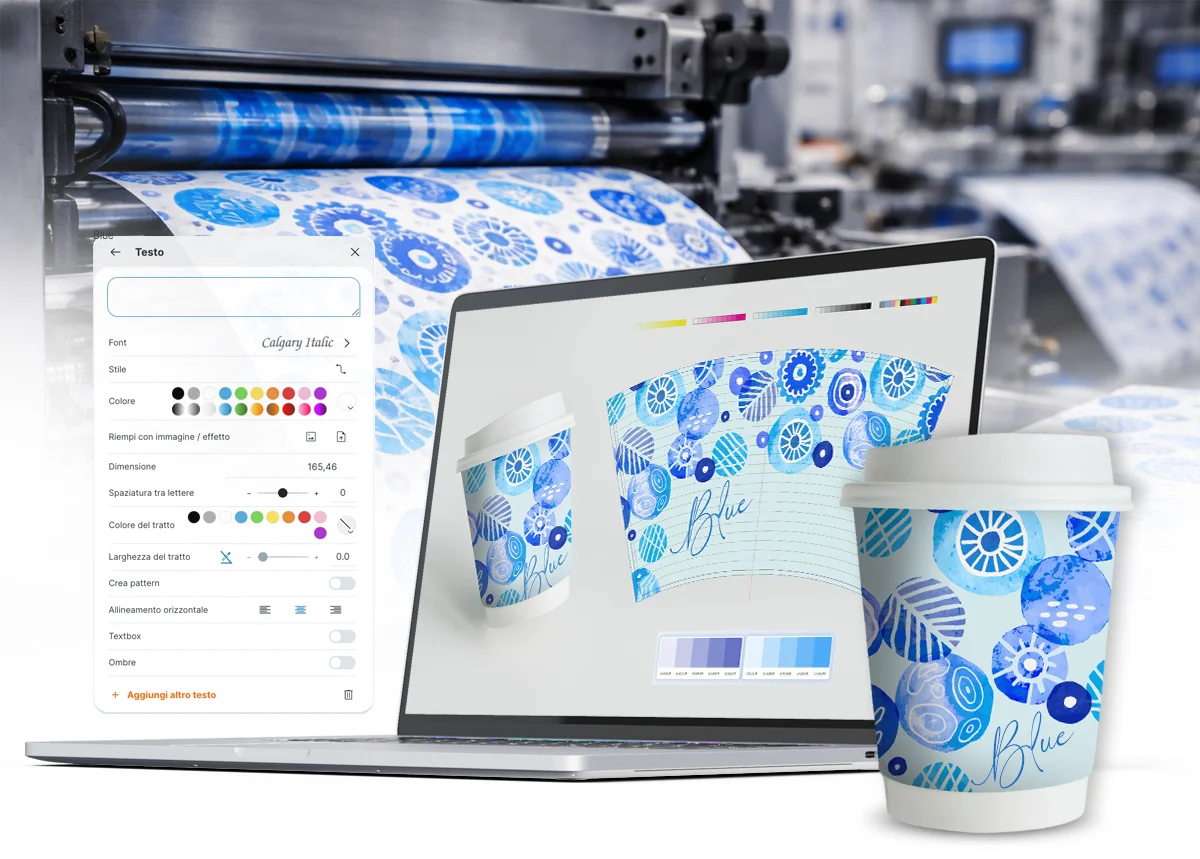
Customization is no longer a niche in printing. For many manufacturers, it’s now a growth engine: made-to-order, personalized jobs customers expect to configure online and receive fast.
But as volume rises, margins often don’t. Not because production can’t keep up, but because the workflow before production wasn’t built for this kind of demand, and pre-press becomes the bottleneck that quietly absorbs time, talent, and profitability.
The silent contradiction in modern printing
From the outside, custom orders look like a clear growth opportunity. They command higher prices, enable differentiation, and strengthen customer relationships. But inside many printing organizations, they tell a different story.
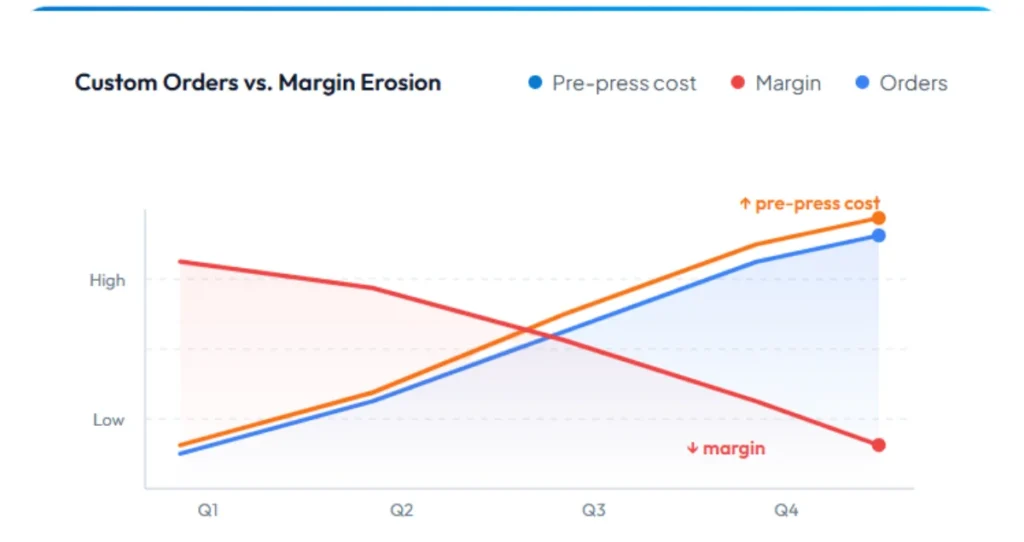
As custom volume increases, margins decline. Designers become overwhelmed. Approval queues grow. Production waits, even though machines are ready.
This contradiction is not caused by complexity alone. It’s caused by a structural mismatch between modern production capabilities and legacy pre-press workflows.
At the center of this mismatch is one idea most teams take for granted: that “final” is something humans decide after the fact.
Why “final” doesn’t really exist
In most printing workflows today, “final” is not a system state. It’s an email. A comment. A message saying “approved.”
The actual decision is detached from the output. It lives outside the file, outside the system, and outside production logic. That separation is what creates friction.
A proof is exported. Feedback arrives via screenshots. A small change is requested. A new version is generated. Another approval is chased. Each step requires interpretation. Each interpretation introduces risk. Each risk requires manual checks.
This is how pre-press quietly becomes the most expensive department in the operation. And as volume grows, this cost does not scale linearly. It accelerates.
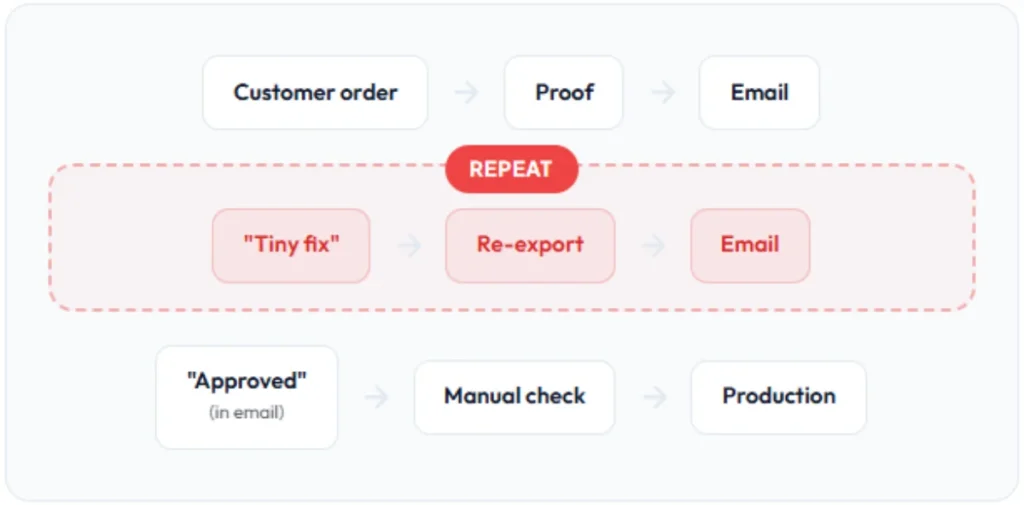
The real reason margins erode with custom growth
Most proof-based workflows scale by adding people.
More designers to handle revisions.
More operators to check files.
More coordination to avoid mistakes.
What appears to be quality control is often ambiguity management. Static files like PDFs and screenshots cannot enforce production rules. They can only represent a moment in time that someone else must interpret.
This is why many printing manufacturers experience a dangerous pattern: more custom orders lead to more pre-press hours, and more pre-press hours lead to less margin.
Zakeke’s core belief: pre-press must move upstream
Zakeke was built on a simple but radical idea: pre-press should not be a downstream safety net. It should be part of the ordering experience itself.
Instead of asking humans to fix errors after they happen, Zakeke enforces production rules at the moment decisions are made. The customer’s browser becomes the first pre-press department.
This is not about better previews or nicer configurators. It’s about transforming customer input into deterministic production instructions.
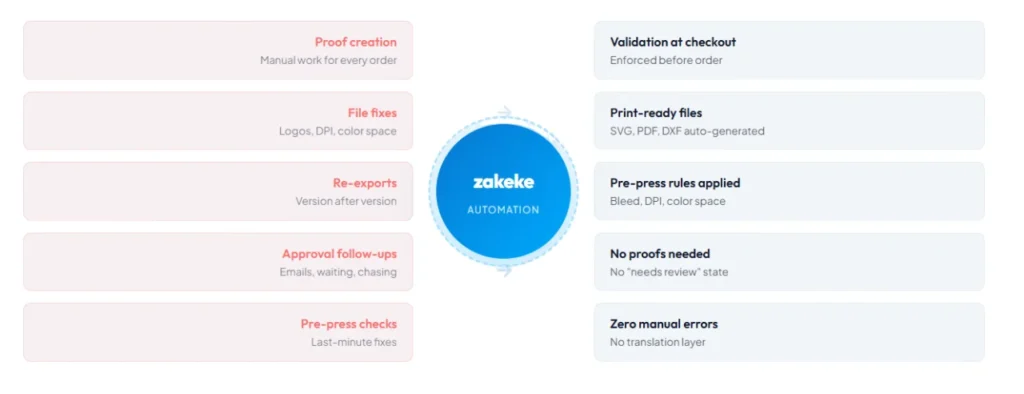
Margins, DPI, color spaces, print methods, engraving constraints, and technical limits are validated in real time. If an order can be finalized, it is already production-ready.
In this model, approval is no longer a negotiation. It’s a consequence.
From customization tool to production infrastructure
This is why Zakeke does not position itself as a simple customization layer.
At its core, Zakeke is production infrastructure for high-volume custom manufacturing.
What the customer finalizes is exactly what production receives. No reinterpretation. No manual translation. No “just to be safe” checks before printing.
Zakeke automatically generates print-ready files such as SVG, PDF, and DXF, under the manufacturer’s rules. Multiple printing methods are supported. CMYK and Pantone color management are enforced. Engraving effects are not visual simulations, but production-ready outputs.
Decisions live inside the product, not in inboxes. This is what it means to turn the browser into a pre-press machine.
Why this changes the economics of custom printing
When pre-press is embedded upstream, something fundamental changes.
- Invalid orders never enter the workflow.
- Manual checks are reduced by design.
- Designers focus on system quality instead of file cleanup.
- Production receives consistent, deterministic input.
- Most importantly, cost stops growing faster than volume.
Custom orders no longer require proportional increases in pre-press labor. Margins stabilize. Throughput becomes predictable. Growth stops being stressful.
This is the difference between scaling customization and scaling chaos.
A broader shift the industry can’t ignore
The printing industry is facing pressure from every direction. Customers expect personalization. Volumes fluctuate. Skilled labor is scarce and expensive. Margins are under constant pressure.
In this environment, continuing to scale custom production through approvals is not sustainable.
Zakeke challenges a long-held assumption: that pre-press must always be a manual checkpoint after the order. Instead, it argues that pre-press is a design problem, not a staffing problem.
The manufacturers who adopt this mindset are not just optimizing workflows. They are redefining how value is created in custom printing.