

ABT Mailcom has built a reputation over two decades as the go-to partner for municipalities, utilities, and businesses across Wisconsin, Illinois, and the US. While larger mail houses focus on high-volume, homogeneous jobs, ABT has carved out a thriving niche by serving the customers others overlook—small to mid-sized organizations that need responsive, reliable mail services with the personal attention that enterprise providers simply cannot deliver.
As demand for ABT’s services continued to grow, Production Manager and Partner Kevin Poeschel—a 20-year company veteran and recipient of the 2025 United States Postal Service Bronze level Industry Member of the Year Award for his work with the Milwaukee PCC (Postal Customer Council) — recognized an opportunity to strengthen the company’s operational foundation. The goal is to implement automation and workflow optimization that enable ABT to scale efficiently, maintain its exceptional service levels, and position the company for continued expansion.
To achieve this vision, ABT partnered with Solimar Systems, Hansen360, and RISO—assembling a team of experts whose combined capabilities would transform how ABT approaches high-volume, variable mail production.
A Strategic Position in a Specialized Market
Based in Lake Geneva, Wisconsin, ABT Mailcom occupies a uniquely advantageous position in the Midwest—situated within 45 minutes of Milwaukee, Madison, and Chicago. This geographic sweet spot, combined with ABT’s specialized focus on first-class and marketing mail, has enabled the company to build strong relationships with municipal governments, utility providers, and regional businesses throughout the Midwest.
"We've always focused on being the partner that smaller organizations can count on," explains Poeschel. "Municipalities, water districts, tax offices—these customers need flexibility and personal service. That's where we excel."
ABT’s strategic growth trajectory accelerated six years ago with the acquisition of Mailcom Consulting, which brought substantial municipal billing work into the company’s portfolio. Today, ABT processes nearly 150 distinct jobs monthly, handling everything from routine utility statements (billing, statements, and invoicing) to high-stakes tax bills—including nearly one million tax notices during peak season.
Investing in Infrastructure for Accelerated Growth
With customer demand increasing and ABT’s service offerings expanding, Poeschel identified an opportunity to enhance the company’s operational capabilities. The existing workflow—while effective—relied heavily on manual processes for sorting files, separating pages, and setting up jobs. As volumes grew, these manual touchpoints represented opportunities for optimization.
"We had solid processes in place, but I could see that automation would allow us to take on more work without proportionally increasing complexity," Poeschel notes. "It was about building the foundation for where we wanted to be in five years, not just solving today's challenges."
ABT had already invested in equipment upgrades, transitioning from Bell & Howell Swing Arm inserters to high-speed BlueCrest inserters, which more than doubled throughput—from 6,000-7,000 pieces per hour to over 11,000. The next logical step was to implement software automation to maximize the return on these hardware investments.
Assembling the Right Team: Solimar, Hansen360, and RISO
After evaluating multiple software solutions, Poeschel attended a Solimar Systems customer event in Chicago that proved decisive. The comprehensive capabilities of Solimar’s platform—combined with Hansen360’s professional services implementation expertise and RISO’s financing and support resources—created a compelling partnership opportunity.
"I had been looking at different software options, and each one had pieces of what we needed," Poeschel recalls. "When I saw the full Solimar ecosystem demonstrated and met the Hansen360 team, everything clicked. They could deliver everything we were looking for in a unified solution."
RISO played a crucial early role in the partnership, providing test files to validate the solution architecture and offering financing options aligned with ABT’s investment timeline.
"RISO was fantastic," Poeschel says. "They worked with us on financing that fit our business model—we didn't need a standard term, and they accommodated exactly what we needed. That kind of partnership makes all the difference."
A Phased Implementation Built for Success
Hansen360 designed an implementation strategy that delivered immediate value while laying the foundation for comprehensive automation. Rather than a disruptive all-at-once deployment, the team took a measured approach that kept production running smoothly throughout the transition.
"We look at each client's work mix and current processes," explains Hansen Longfellow, President of Hansen360. "ABT didn't need an enterprise-scale implementation—they needed right-sized automation that would grow with them. Kevin was incredibly engaged throughout the process, which allowed us to design solutions that fit exactly how ABT operates."
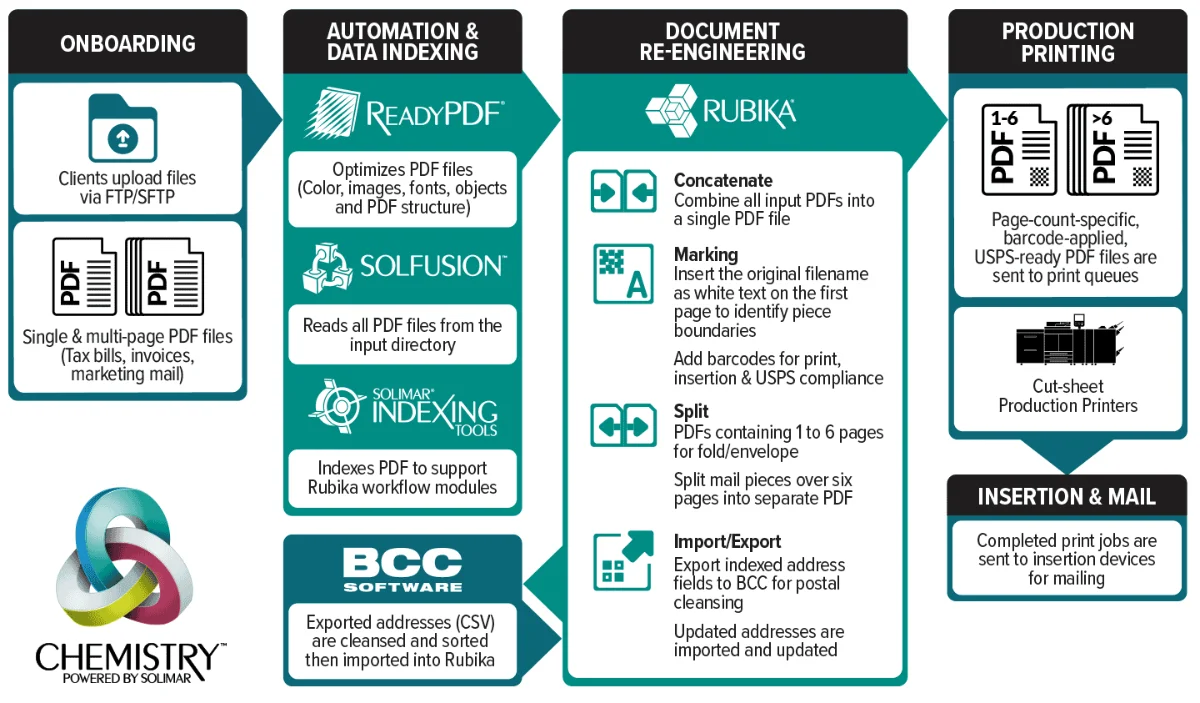
The implementation began with targeted solutions to ABT’s most complex file-handling requirements, including automated separation of variable-length documents and intelligent page-count detection. Within two weeks of full deployment, the Solimar system was processing files end-to-end: automated page separation, barcode application, postal optimization through BCC Software integration, and output file preparation.
The Solimar Chemistry platform solution stack includes ReadyPDF for file optimization, SOLfusion and Rubika for workflow orchestration and document processing—all working together to transform incoming files into production-ready output.
Measurable Results Across Every Dimension
KEY PERFORMANCE IMPROVEMENTS
⏱ Processing Speed: File processing reduced from 15-30 minutes to 2.5 minutes per job
📈 Capacity Expansion: Confidently handling 90-150 jobs monthly with room to grow
📄 Enhanced Capabilities: Expanded inserter-ready processing from 4 pages to 7-8 pages per mail piece
🚀 Peak Season Success: Processing up to 1 million tax bills in three weeks with optimized workflows
💰 Postal Optimization: Processing our customers’ work in-house enabled us to deliver greater postage savings and the maximum postal discount available.
🔄 Operational Efficiency: Setup and job changeover times reduced from hours to minutes
The transformation in processing speed alone has been remarkable. What previously required 15 to 30 minutes of manual file handling now takes approximately 2.5 minutes with automated hot folders and intelligent workflow routing.
"The time savings are significant, but what really matters is what that time enables," Poeschel explains. "We can take on more customers, deliver faster turnaround, and our team can focus on quality and customer service instead of repetitive manual tasks."
Expanded Service Capabilities
Beyond efficiency gains, the new workflow has expanded the offerings ABT can provide to customers. By leveraging 2D barcodes to verify piece integrity, ABT now processes mixed-length jobs—documents ranging from single pages to 7 or 8 pages—in a single production run. Previously, this would have required multiple setups and careful manual oversight.
"We used to be comfortable up to four pages," Poeschel notes. "Now we're routinely running seven- and eight-page pieces. That opens up opportunities we couldn't touch before—more complex statements, multi-page tax documents, enhanced marketing materials."
The postal optimization capabilities have also created new value propositions for customers. By integrating BCC Software for USPS presort automation, ABT can now offer better sorting levels and apply more postage discounts and promotions—savings we share with customers as a competitive differentiator.
Peak Season Performance: A True Test of Capability
Tax season is ABT’s most demanding period, with nearly 1 million tax bills processed in about 3 weeks across over 400 cities, towns, and villages. This demonstrates the real-world value of ABT’s investment in automation.
"At the beginning of the year, the calendar compressed our timeline—files arrived later, but mailing deadlines moved earlier," Poeschel recalls. "The automated workflows made it possible to meet every deadline. Our team finished the season confident rather than exhausted."
The impact was particularly evident in the reduction of manual intervention. Tasks that previously required extensive hand-sorting and physical processing—including handling of multi-page documents—now flow through automated workflows with minimal human touchpoints.


