In this environment, floor space must be viewed as a financial metric. Every square metre allocated to hardware must justify its cost through maximum output.
The Real Estate Efficiency Problem
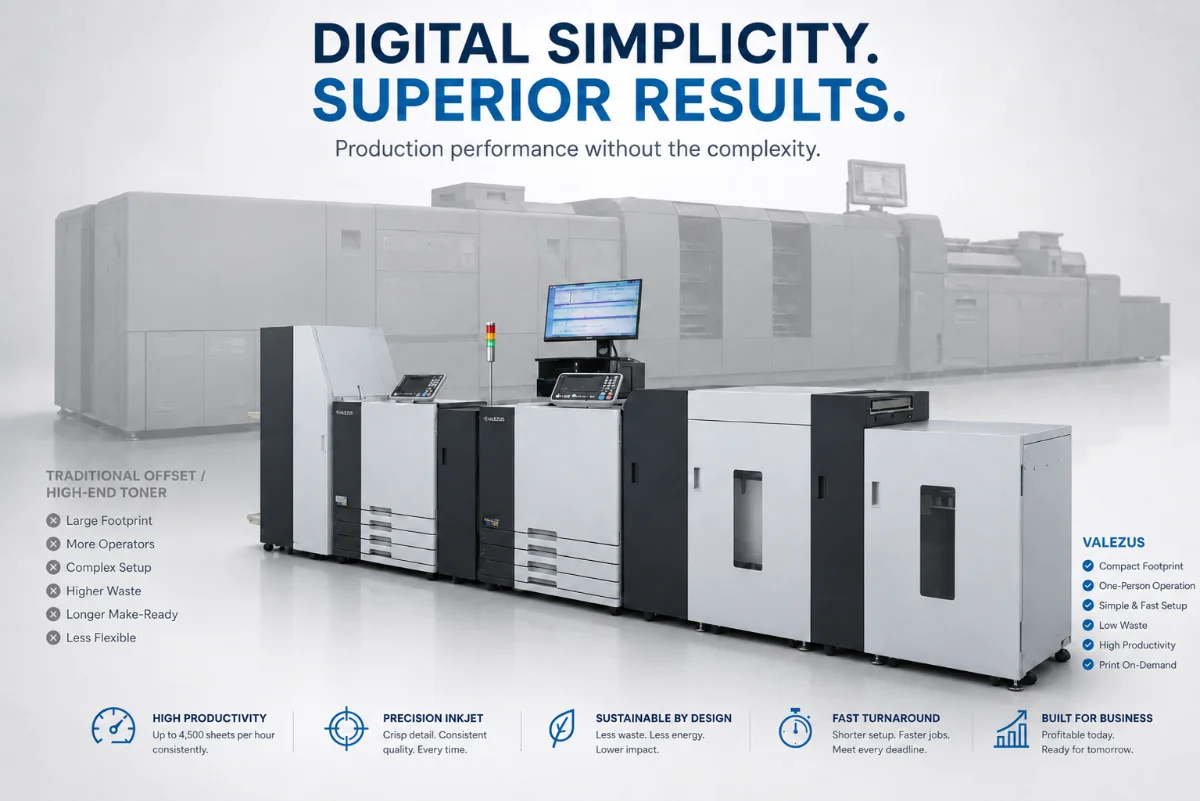
Traditional high-volume printing equipment, particularly litho presses or high-end production toner lines, carries a massive physical footprint. Beyond the actual length of the machines, these systems require extensive auxiliary footprints: complex ventilation ducting to handle heat, broad clearance zones for service access, and climate-controlled storage for sensitive consumables.
When you factor in these “hidden” spatial requirements, adding a new production line can easily force a business to consider a costly relocation or expansion.
Maximising Yield Per Square Metre
At RISO, we design technology around the reality of the modern production room. Because our FORCEJET™ inkjet hardware relies on a cold, mechanical process, it completely changes the spatial economics of a print facility:
- Ultra-Compact Engineering: RISO high-speed systems deliver up to 330ppm duplex within a footprint that is significantly smaller than comparable toner devices.
- Zero Thermal Clearance: Because our machines generate no heat, they do not require bulky external ventilation hoods, expansive ducting, or wide-open clearance zones just to keep the ambient room temperature stable.
- Integrated Simplicity: High-capacity feeders and finishers are built inline and tightly integrated, ensuring that a full, automated production unit can be deployed against a single wall.
Adding Capacity, Not Overhead
The “New Narrative” for independent printers isn’t necessarily about expanding physical walls; it is about expanding digital capability within existing boundaries.
By replacing bulky, heat-generating equipment with compact, high-yield inkjet systems, commercial printers can scale up their print capacity and introduce new revenue streams—such as high-speed transactional mail—without increasing their rent or business rates. In a market where floor space is money, the most profitable technology is the one that delivers maximum volume from a minimal footprint.