
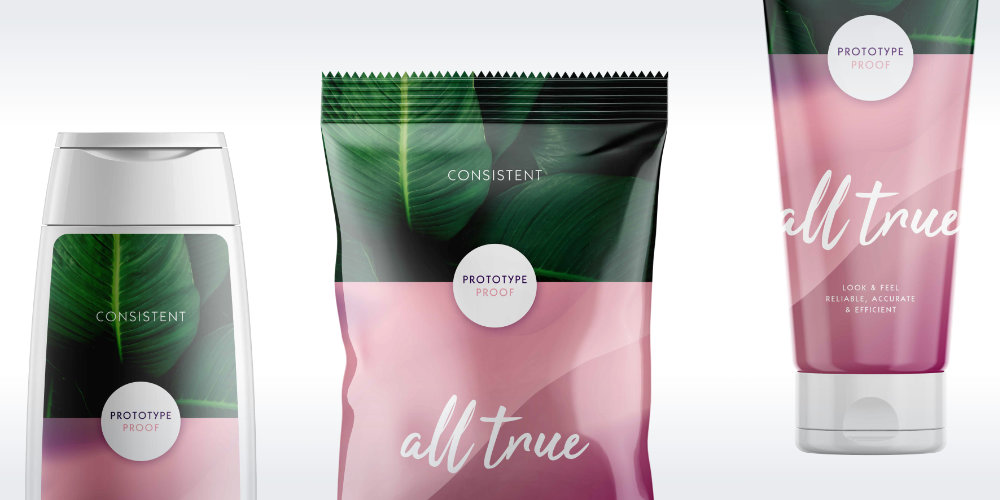
In addition to the most precise colour reproduction possible, many packaging printers want proofs that also show the tactile properties of the substrates. This additional dimension makes it much easier to assess a proof, so important decisions can be made before print production.
In addition to the most precise colour reproduction possible, many packaging printers want proofs that also show the tactile properties of the substrates. This additional dimension makes it much easier to assess a proof, so important decisions can be made before print production.
The purpose of a colour-accurate proof has always been to simulate the final print result as accurately as possible in the run-up to production. Firstly, this enables colour matching at the pre-press stage and therefore reduces the make-ready time of the press. And secondly, it allows you to assess the properties of a final print product as early as possible with all stakeholders involved in the process.
In packaging production this is not limited to ink. The special properties of the substrates – especially their feel – also play an important role in the assessment. As well as evaluating finishes, some customers may even want the three-dimensional look-and-feel of a real 3D sample. No wonder that the desire for colour-accurate proofs on production or comparable substrates is now omnipresent in packaging printing.
In practice, however, proofs for packaging printing are currently mostly produced on paper-like substrates. If a design is to be simulated on media other than paper, there is the option of using UV inkjet systems or the more widespread water-based inkjet printers. Unfortunately, the colour gamut of UV inkjets is very limited, and their operation is quite complex due to their chemical emissions. With water-based printers, on the other hand, the choice of substrates is very limited. Moreover, the print quality of these devices on foils is not satisfactory for most users. And the drying times on non-absorbent substrates are usually far too long. However, a convincing alternative comes in the form of eco-solvent inkjet. The effort required to operate these systems is comparatively low and the range of suitable substrates is much wider than with water-based inkjet. Another advantage is that white and metallic inks can be used.
One system – many possibilities
The colour experts at GMG know the advantages and disadvantages of different printers and rely on eco-solvent technology for prototype proofing with the Epson SureColor SC-S80600.
Jens Zehnder, print engineer at GMG, is convinced that flexibility is key in prototype proofing: “Even if the original substrate cannot be used for proofing due to certain surface properties, our solution still offers the option of using transfer foils. These are laminated onto the desired material after printing. Even complex tasks, such as the use of metallic inks, can be realised very easily in this way. Because by using metallised foils, you avoid the difficulties that metallic pigments bring with them.”
Anyone who wants to create ready-made 3D patterns with accurate colours in addition to the two-dimensional result should also consider the further processing properties when selecting a substrate. The portfolio that GMG offers leaves virtually nothing to be desired: from shrink films for shrink sleeves, to cardboard for folding boxes, to various self-adhesive films that suit label designs. For customers who have previously only used paper proofs, GMG guarantees a smooth upgrade to prototype proofing. The fact that a GMG proof stands for maximum colour reliability is no secret among professional users. And the new variety of substrates makes GMG’s reliable solution an unbeatable total package.
More than accurate colour – Tactile substrates open a new proofing dimension
Prototype proofing is a huge step towards even more accurate predictions of the final product, especially for the packaging market. Now it is possible to use a realistic simulation – either in the form of a flat prototype proof or a ready-made 3D sample – to assess in advance exactly how the printed packaging will look. The decisive added value lies in the reliability and efficiency of the approval process: print approvals are shortened and customer trust is built.


