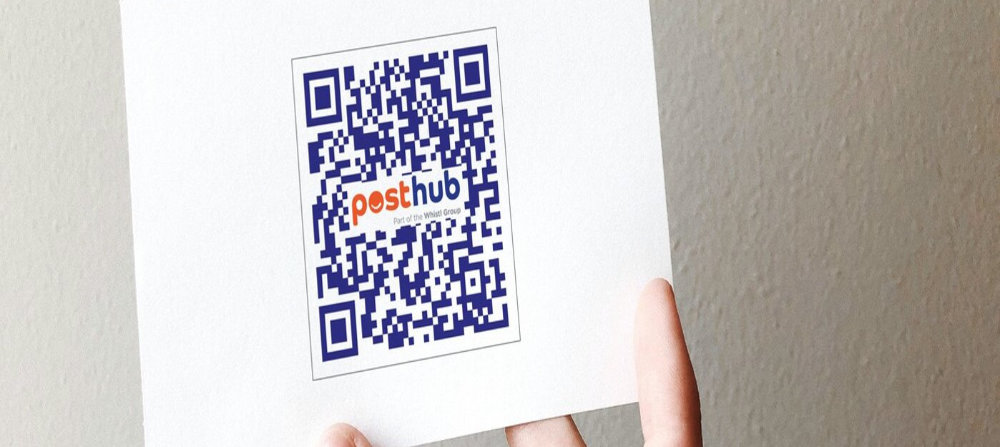
We live in a connected world, and with the last couple of decade’s advancements in technology, we are now in a position where our phones can do almost everything for us. Our mobile phones have become our credit cards, cameras, diaries, and allow us access to a number of different communication channels (calls, emails, messages or short texts).
Posthub details how print advertising can be more digitally connected, with the use of QR technology.
Create Connected Mailing Campaigns
By allow your mailing campaign to connect the offline world with the online world, with simple QR technology could help your audience connect seamlessly with relevant and live content. This technique gives your campaign more creative flexibility, as the content on the page can be changed as often as you need, with no impact on the printed item.
What is a QR Code?
A Quick Response code is a form of barcode that can easily be scanned by a smartphone used to track information about products and often used in marketing and advertising campaigns. QR codes are easy to add to direct mail and can take those who use them to a wide variety of actions and locations.
With Apple’s 2017 iOS 11 updates and Googles Android 9 and 10 smartphone update, it became easy to simply scan QR codes directly through the internet-connected phone cameras. Meaning you no longer needed to download a special app to scan a QR.
QR Code Usage
Though the technology and QR codes have been around since the early 2000’s, we have seen a welcome increase in their usage. When first launched, QR codes did not have a strong awareness of what they could do for the general public, and smartphone ownership in the UK was roughly half the population. Fast forward to now, around 95% of the population own a smartphone, a MobileIron survey in September 2020 showed 27.5% of respondents in the United States and the UK had used a QR code as a payment method. The same survey highlighted 32% of consumers had scanned a QR code in the last week.
Successfully incorporate QR codes into your Direct Mail campaign
Posthub has outlined below a couple of examples of how QR codes can be used on printed materials to improve your campaign results:
Business Cards: If you want to add a QR code to a business card, you may want it to lead somewhere general like your portfolio, LinkedIn account or the contact details on your website, or maybe even your Google my Business account showing your office location.
Promotional Items: For promotional items create a link that directs them to an exclusive offer code or a webpage where they can purchase your goods or services. This destination page can be updated based on real-time available inventory or your availability to fulfil a service, giving the consumer more control in the buying cycling at the point of purchase.
Smart Direct Mail: With QR codes you can create a smart direct mail that allows your customers to interact with the mail they receive. If it links to your social media platforms it also gives your customers a way to reach you. When a customer scans the QR code on your direct mail piece, even if they don’t act on it, they can be retargeted on Google or Facebook, thereby increasing your ROI.
Customised QR Codes: Advanced QR codes allow you to create live and continuous marketing campaigns, that can be changed as regularly as your campaign needs. Adding an agile destination from your QR code within your Direct Mail means your campaign could be in constant use. For example, if you wanted to send your audience something that they could keep in their house like a fridge magnet or other promotional item, the recipient will simply scan the item QR code, to see the current exclusive offer, helping you manage the marketing message on a regular basis.
What are the benefits of using QR codes?
Free & easy to create: There are a number of websites that allow you to create a personalised QR code for free. Once created this code can be applied to your print materials.
Easy to use: For both the user and advertiser
Personalisation: QR codes no longer have to be just black and white, you can create more of identity with our own brand colours and or logo
It only takes up a small amount of space: Because of its size, you can fill your artwork with information, imagery and offers. The recommended size of a QR code should not be printed smaller than 2 cm x 2 cm, allowing it to be scanned easily.
Effortless CTA: With the increased awareness of the technology, most of your recipients will know how QR codes work, so you may only choose to accompany the code with a simple instruction like ‘use your phone’s camera to scan me’.
Measurable: QR codes are easily measured, allowing you to capture more about your response rates and your customer’s online behaviour.
Create a Direct Mail campaign with a QR Code:
With Direct Mail being delivered directly into the home of your target audience, it is a channel that is hard to ignore. With items staying within the household for nearly 8 days, Direct Mail continues to be a channel that should be included within your advertising media mix.
Before you start your campaign creative, ensure you include:
A test stage: to check that the code can be easily scanned across different mobile devices and that it links through to the correct place.
Destination pages are mobile-friendly: If directing them to a website, ensure the destination page mobile-friendly.
Call to action and clear instructions: If the objective is to use the QR code to encourage the use of your company’s services or buy a product. Include simple instructions such as ‘scan here to receive our exclusive offers’ or ‘scan me to be a part of our mailing list’.
Read more advice and get postal management support from Posthub at www.post-hub.co.uk