
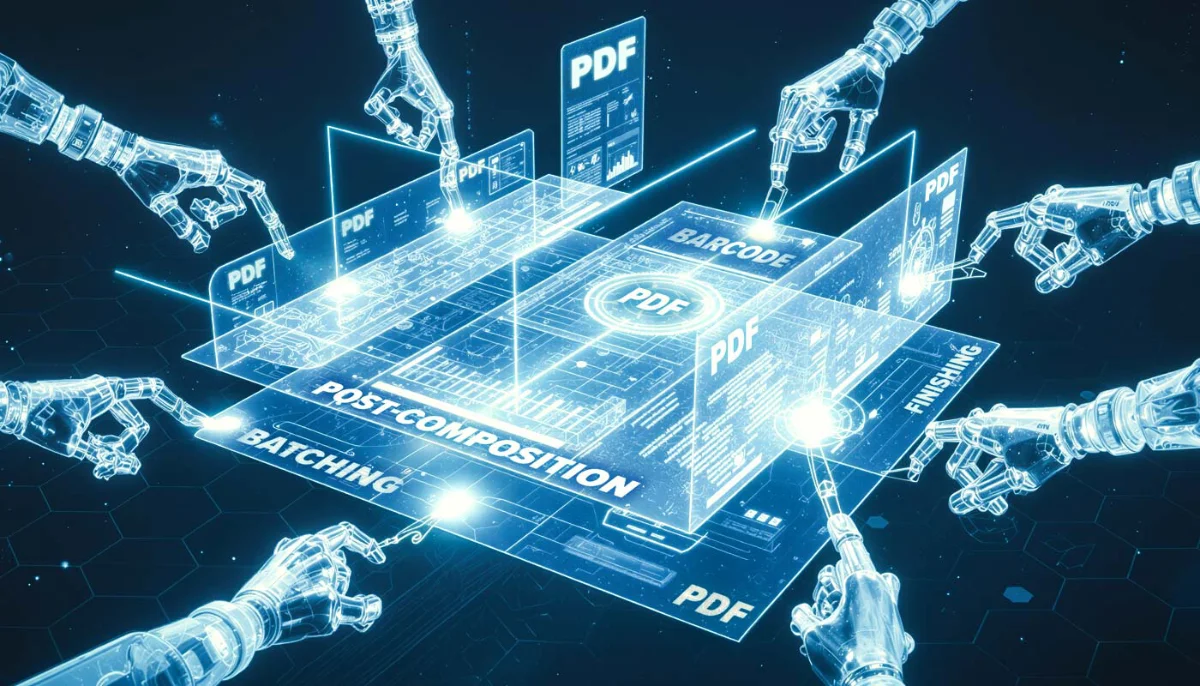
It’s the place where a job gains the structure that carries it smoothly to completion.
Operators know this stage well. They’re the ones opening files, checking page logic, verifying barcodes, adjusting break points, and applying their expertise to keep work moving. Supervisors see the results in schedule reliability, consistent device performance, and smooth production runs. Leadership sees it in meeting SLAs and satisfied clients.
The principle is straightforward: When the middle of the workflow is well-governed, the rest of the workflow becomes predictable—and predictability is where opportunity lives.
Post-Composition as the Stabiliser
A strong post-composition process acts as the equaliser—it takes in whatever clients submit and transforms it into something predictable. This includes:
- Normalising structure
- Applying finishing logic
- Generating barcodes
- Inserting marks and integrity controls
- Defining breaks and chapters
- Managing postal logic
- Preparing files for specific press and finishing equipment
Automated PDF correction tools play a crucial supporting role here. They remove transparency issues, embed fonts, normalise colour, and optimise page resources so that downstream processors run cleanly. This work happens behind the scenes but dramatically strengthens production reliability.
The result is that operators don’t start each job by troubleshooting—they start by executing.
Ganging for Roll-Fed Efficiency
One of the most compelling advantages of strong post-composition is ganging—combining multiple smaller jobs into a single, efficient print stream that maximises roll-fed inkjet performance. Roll presses thrive on long, uninterrupted runs. They hit their stride when the workflow keeps them fed with continuous volume.
Post-composition automation makes ganging practical and powerful:
- Job boundaries are managed seamlessly
- Postal logic remains intact
- Client separation is maintained with precision
- Integrity is preserved throughout
- Reprints remain straightforward
Automated post-comp systems address these challenges by evaluating job attributes and intelligently grouping work, giving production the economies of scale of larger jobs without sacrificing piece-level control.
Predictability: The Currency of Growth
When the middle of the workflow becomes predictable, the entire operation benefits. Finishing crews receive well-built files ready for production. Operators focus on execution rather than correction. Schedulers gain confidence because device behaviour is consistent. Exceptions become rare – uptime increases. Throughput climbs.
And reprints—once a source of frustration for many operations—become managed events. Because every piece is controlled and accounted for, the system always knows what needs to be reprinted and why, making recovery fast and routine.
The Cultural Shift Behind a Controlled Workflow
Technical stability is only half of the transformation. The more profound shift happens in the culture:
- Operators begin trusting the system
- Supervisors regain the bandwidth to lead instead of chasing
- Teams collaborate because the rules are shared
- Leadership sees the operation more clearly
- The business can take on more work with confidence
Post-composition is no longer a technical step—it becomes the operational heartbeat.
Leadership question:
What would your operation gain if the middle of your workflow—once a stage that required constant attention—became the part you trust the most?
Read the full article – https://www.solimarsystems.com/blog/visibility-is-not-optional-track-everything-with-solitrack-part-5/


