For brands operating in printing, promotional and manufacturing, customization is no longer a competitive edge. It is expected. Customers want to personalize products instantly, see results in real time, and move smoothly from configuration to purchase.
But behind many of these experiences, the reality is still complex and inefficient.
Most custom orders still follow a fragmented workflow. An order comes in, a proof is created, emails are exchanged, changes are requested, files are reworked, and production waits for final approval. This loop repeats across orders, creating delays, increasing manual workload, and introducing unnecessary risk.
As shown in typical workflows, this process does not scale. Teams spend time managing proofs and approvals instead of focusing on growth. Designers are pulled into repetitive tasks, while production is slowed down by uncertainty and waiting time.
The challenge is not customization itself. It is the way it is managed.
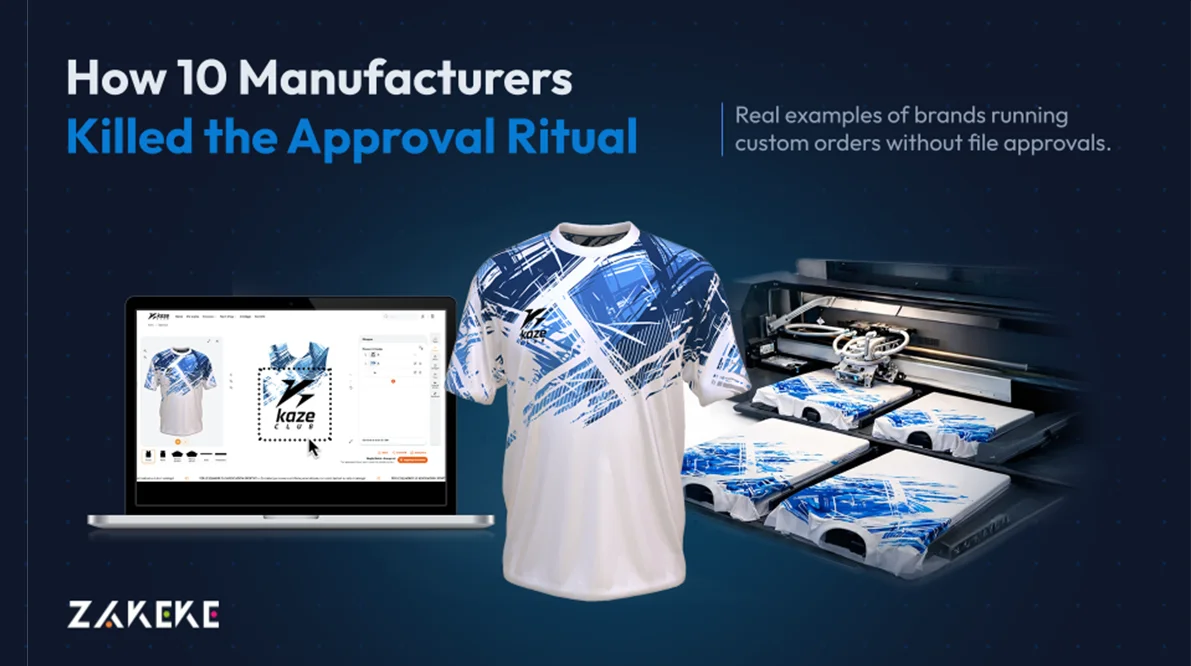
A different model is now emerging. Instead of relying on manual approvals and file checks, leading brands are embedding production logic directly into the customer experience. Every configuration is validated in real time, and every output is generated according to predefined rules. What the customer sees is exactly what production receives.
This approach effectively turns the browser into a pre-press environment, where orders move directly from configuration to production-ready output without additional steps. Validated files are generated instantly, with no need for proofs, revisions, or manual intervention.
The impact is significant. Workflows become faster and more predictable. Errors are reduced. Teams can handle higher volumes without increasing operational complexity. Most importantly, production can start immediately, without waiting for approvals.
This shift is already happening across industries where customization is a core part of the business.
Here is a free lookbook that explores how some brands are rethinking their workflows and moving from approval-driven processes to production-ready systems. It outlines how brands are removing friction from custom orders and building operations that scale with demand.