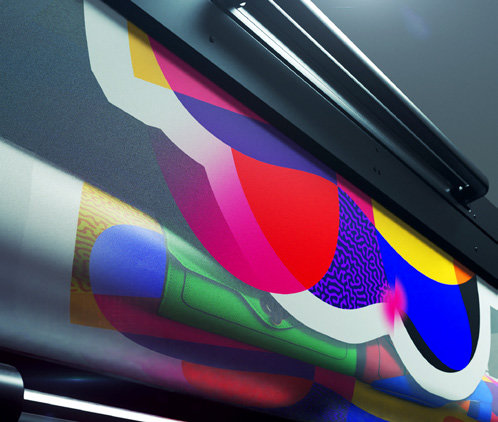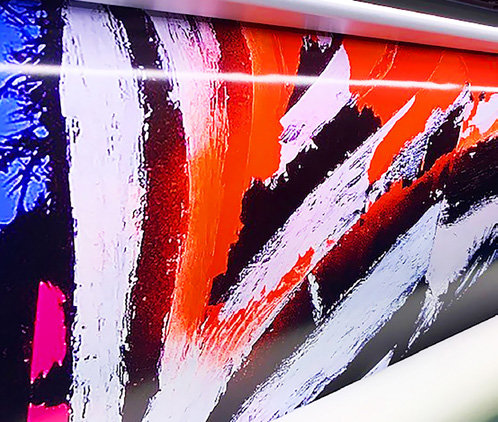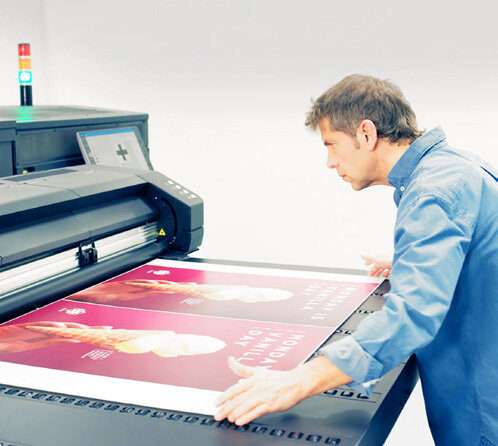
The world has changed, and you need to keep up. Here is how printers can stay ahead with new practical applications and technology that can help them capitalise on creative drive, experience, and determination.
Print businesses have a chance to push the boundaries of what is possible with wide-format printing. It is time to deliver more innovative, useful, and digitally enhanced products that help your clients meet their customers’ demands.
We have put together a selection of the latest print application trends to help inspire your product and service offering. From personalised interior décor to durable vehicle wraps, here are four ways wide-format print is set to make an impact on the world around us—and how you can get involved with practical applications.
Inspiring interior decoration
Many businesses have seen the recent changes as an opportunity to pivot their offerings. And with that comes the need for a new look and feel.
Many hospitality and retail venues are opting for a more modern aesthetic as they return to in-person service, and that means taking inspiration from 2021’s interior design trends, which include natural textures such as straw and wicker. Digital printing makes it easy to produce high-margin, individual interior decoration. Thanks to digital printing, print businesses can provide the level of flexibility and customisation to their customers in this high sector
HP large-format printing solutions are a great fit for the interior decoration market, providing unique benefits whether you are a print service provider looking to expand into new high-margin applications like customised projects or canvas; a wallcovering or window blinds manufacturer looking to differentiate with high-end, luxury collections; a designer looking to create an advantage with shorter design-to-manufacturing time; or an interior decorator with a vision for creating experiences through spaces. Thanks to the versatility of HP Latex all of this is possible.
In situations where functionality matters, print providers can offer detailed, faux-textured prints on different wallpaper—delivering similar aesthetics in a more practical material.
In addition, printers can infuse their digitally-printed wallpapers with specific properties by using antibacterial and antiviral substrates, and even include performance coatings to enable more frequent washing. This is not only ideal for sensitive applications like hospitals and care facilities, but also helps busy sectors like services and events stay compliant in the more hygiene-conscious post-COVID world. Thanks to these unrivalled customization options and end user benefits, market research consultancy Technavio expects the digitally printed wallpaper market to grow by $4.81bn (£4.06bn) between 2021 and 2025.
Vivid vehicle wraps
Research from the Royal Institution of Chartered Surveyors shows that the largest cities have lost up to 15 percent of their urban population. The majority of these movers have decided to relocate to suburban or semi-rural areas, in part due to increased remote working opportunities and lower costs of living.
At the same time, the pandemic has resulted in an explosion of deliveries–both for online shopping and takeout food. The total number of e-commerce deliveries rose by 25 percent in 2020, according to a study from the World Economic Forum.
The report suggests that the pandemic has reshaped last-minute logistics to adapt to this increased demand, and forecasts that
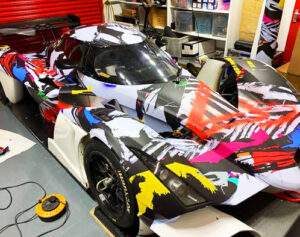
our reliance on deliveries is here to stay. To adapt to this new population distribution, businesses are already taking advantage of high-quality vehicle wraps. The global automotive wrap market was valued at $4bn (£3.37bn) in 2020 and is set to grow by an average of 22.4 percent each year until 2028. Your potential customers are taking advantage of these moving billboards to grab attention in suburban areas, helping to make up for the lost footfall in busy urban centres.
A great example for demand in vehicle wrapping shows the print service provider MediaCo, which offers a unique range of specialist print services, from wallpapers to racing car livery wraps, working with a wide range of market sectors to produce contemporary exhibition and interior display graphics, sports and live event branding and out-of-home advertising displays. In the last two years, MediaCo has purchased two HP Latex 3600 printers from Papergraphics and one HP Stitch S1000 printer from RA Smart, with a second HP Stitch S1000 device now being considered.
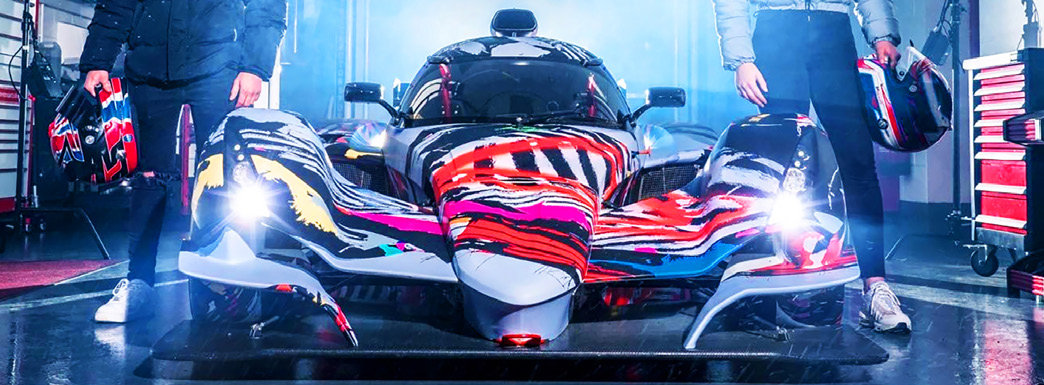
“The HP Latex machines have been put to work on some astounding projects. We took a strategic decision to add HP water-based printers to our production capabilities which now totals three machines – a trend we see continuing as the print quality and reliability of the machines is excellent and they align perfectly with our sustainability strategy.”
Stephen Arthur, MD of MediaCo
Wonderous white ink
The practical applications of vehicle wrapping can vary significantly. While some clients may want the entire exterior covered in graphics, others may prefer a more minimalist approach on their cars and vans. For these, applications, you will need more flexibility – especially as over 20 percent of vehicles in the UK are painted black, which will require printing onto darker substrates. White inks deliver a solid foundation that allows you to print colour-accurate graphics and text onto any colour or tone. Applying a base layer of white ink before your main printing run acts as a blank canvas and means that print providers can now deliver products across a wide range of material colours–helping you deliver better, more versatile vehicle wraps for your customers.
A sign-post to new profits
With the rise of hybrid working, the expectations of what a physical
space should do have completely changed. Online solutions have established themselves as more convenient alternatives for users and consumers. Spaces such as offices, retail, and events need to offer a better user experience to encourage people to return. And that’s where printers can help.
Studies from the Sign Research Foundation show that 60 percent of businesses improved their sales by an average of 10 percent after updating their navigation signage. When we hear the term ‘wayfinding’, many of us think of maps and directional arrows. But with wide-format printing, you can be more creative. Murals and artwork can provide memorable reference points that draw the end user’s attention towards specific locations.
Other examples of printed wayfinding include:
- ‘Zoning’ signage and wall prints, which can separate areas into distinct spaces based on colour and design.
- Durable floor signage that guides foot traffic into lanes and helps direct people through complex spaces.
- Bold, icon-based prints that help convey information visually.
- Step-by-step guides split across multiple prints —particularly helpful for large locations with separate buildings such as airports and hospitals.
- High-resolution photos with graphics and markers.
- Consistent signs to designate room, building, or space
names—all using the same shapes, colours, and fonts.
Wayfinding signage can be implemented into almost any location. From office buildings and shopping centres to events and conference venues–wide-format printers can give businesses the tools they need to deliver a better, more convenient experience for the people who use their spaces.
Another fantastic example for focus on signage is the print service provider Signbox. Surrey-based architectural signage solutions provider Signbox has praised the role its duo of HP Latex 300 Series printers played in an innovative project that helped the company scoop a host of major honours at the 2021 UK Graphics Awards.
Signbox was tasked with delivering a brand experience to various meeting rooms and areas throughout the new Pernod Ricard UK headquarters at Chiswick Park in West London. Pernod Ricard moved to the 85,000sq ft (7,897sq m) facility in September 2020 and most of the work was conducted during the Covid-19 lockdown.
The project included a range of 3D lettering and signage alongside of stunning wallpaper backdrops – all of which were printed on Signbox’s HP Latex Series printers. Signbox printed the designs on Digimura wallcovering media, a product selected for its environmental credentials and fire-retardant qualities.
“The HP Latex printers produce first-class quality print on any job we run, and this was no exception,” explains Signbox Managing Director Mark Bartlett. He adds: “The HP Latex inks conform so much better to Digimura than other inks; we don’t get the issue of ink sitting on the surface and it doesn’t crack.”
A new reality
As of 2021, 87 percent of UK adults own a smartphone, according to Statista. We are more connected to the digital world than ever before. Wide-format printers have an opportunity to bridge the gap and offer their customers smart prints that can seamlessly interact with the technology they carry around with them every day.
QR CODES
Integrating QR codes into your printed products can offer an intuitive way for users to unlock new digital experiences. As practical applications of QR codes increase across the world, users are becoming more familiar with how they work. Eighty-six percent of smartphone users have scanned a QR Code at least once in their lifetime, and 36.4 percent scan at least one code a week. This provides an opportunity for wide-format businesses to integrate digital connectivity into their printed displays. Large, scannable QR codes are already being used on billboards and advertising displays across the world, and print businesses now have the chance to bring this same level of digital connectivity to their clients’ signage.
AUGMENTED REALITY (AR)
The term ‘augmented reality’ refers to technology that combines virtual displays with the users’ view of the real world. For printing businesses, AR can be used to superimpose digital information onto physical printed products, helping your customers link their printed media to their digital assets. The global AR and VR market is predicted to grow by 42.9 percent by 2030, providing an opportunity for wide-format print businesses to expand their services and deliver AR-enabled products.
AR billboards and other large-format prints give users the ability to interact with advertisements using their phone. In New York City and Los Angeles, social media app Snapchat has partnered with digital marketing agencies to create interactive printed displays that play videos on your smartphone when scanned with the camera app.
AR advertising may only just be getting started, but the market is expected to reach a total value of $6.7bn (£5.65bn) by 2025. As this form of connected marketing becomes more widespread, print suppliers can help create signage that blends the physical and digital worlds. This means creating clear large-format advertisements that can be easily recognized by a smartphone’s camera to unlock interactive features.
Discover how HP Latex inks and printers can help you bring these ideas to life.
PSPs have been evolving for some time, and the turbulence experienced in 2020 and 2021 only accelerated that change. Many are displaying resilience and creativity, and businesses that will survive and thrive will be the ones that are versatile, connected, sustainable, and safe.
HP can help you take the next step to ensure your print business has the best chance of success in the form of its HP Latex R Series, HP Latex 3600 Printer, HP Latex 700W and 800W printers. The combination of HP Latex printers and HP White Ink ensures you can deliver high-quality, attention-grabbing and sustainable graphics to your end-user customers.
Meet us at the upcoming IPIA conference on September 1st on our HP booth and talk to us about your printing requirements or get in touch via phone with your HP sales representatives who can advise you on the best printer to suit your needs. To book your tickets head to ipia.org.uk/ac